Category: Blog

  • 3 Phase Solar Systems

    3 Phase Solar Systems

    As the world continues to shift towards renewable energy, solar power has emerged as one of the most viable and sustainable solutions. Among the various solar technologies available, 3-phase solar systems are gaining significant attention, especially in commercial and industrial settings. These systems not only offer enhanced efficiency but also provide a more balanced and stable power supply, making them an ideal choice for larger energy consumers. In this article, we will explore the benefits, applications, and future potential of 3-phase solar systems.

    Understanding 3 Phase Systems

    A 3 phase solar system is an electrical distribution method that uses three alternating currents, each 120 degrees out of phase with the others. This setup allows for continuous and efficient power supply, making it ideal for high-demand applications. It mainly from 20kw energy systems30kw solar systems , 45kw energy systems and above.

    Difference Between Single Phase and 3 Phase Systems

    • Single Phase: Uses one alternating current, suitable for small residential loads.
    • 3 Phase: Uses three alternating currents, ensuring a constant power flow with higher efficiency.

    Benefits 

    1. Increased Efficiency: One of the primary advantages of a 3-phase solar system is its ability to deliver power more efficiently. The balanced load distribution ensures that energy is used optimally, reducing wastage and improving overall system performance.
    2. Stable Power Supply: The three-phase configuration provides a more stable and reliable power supply. This is particularly important for businesses that rely on sensitive equipment, as it minimizes the risk of power fluctuations and outages.
    3. Scalability: 3-phase solar systems are highly scalable, making them suitable for a wide range of applications. Whether you’re looking to power a small business or a large industrial complex, these systems can be tailored to meet your specific energy needs.
    4. Cost-Effective: While the initial investment in a 3-phase solar system may be higher than that of a single-phase system, the long-term savings are significant. The increased efficiency and reduced maintenance costs make it a cost-effective solution for large-scale energy consumers.
    5. Environmental Impact: By harnessing the power of the sun, 3-phase solar systems help reduce reliance on fossil fuels, thereby lowering greenhouse gas emissions. This makes them an environmentally friendly choice for businesses looking to reduce their carbon footprint.

    Applications 

    1. Commercial Buildings: Office complexes, shopping malls, and hotels can benefit greatly from 3-phase solar systems. These buildings often have high energy demands, and a 3-phase system can provide the necessary power while reducing operational costs.
    2. Industrial Facilities: Factories and manufacturing plants require a consistent and reliable power supply. A 3-phase solar system can meet these demands, ensuring that production processes run smoothly without interruptions.
    3. Agricultural Operations: Large-scale agricultural operations, such as dairy farms and irrigation systems, can also benefit from 3-phase solar systems. These systems can power heavy machinery and irrigation pumps, reducing the reliance on grid electricity and lowering energy costs.
    4. Educational Institutions: Schools and universities with large campuses can use 3-phase solar systems to power classrooms, laboratories, and administrative buildings. This not only reduces energy costs but also serves as an educational tool for students learning about renewable energy.

    Considerations for Installing it in a Residential Property

    1. Initial Investment: The upfront cost of a 3-phase solar system is generally higher than that of a single-phase system. However, the long-term savings and benefits can outweigh the initial investment, especially for homes with high energy consumption.
    2. Electrical Infrastructure: Your home’s existing electrical infrastructure must be compatible with a 3-phase system. This may require upgrades to your electrical panel and wiring, which can add to the overall cost and complexity of the installation.
    3. Energy Needs Assessment: It’s crucial to assess your home’s energy needs before deciding on a 3-phase system. If your energy consumption is relatively low, a single-phase system may be more cost-effective. Consulting with a professional solar installer can help you make an informed decision.

    Installation Process

    1. Site Assessment: A professional installer will conduct a thorough assessment of your property to determine the feasibility of a 3-phase solar system. This includes evaluating your energy consumption, roof space, and electrical infrastructure.
    2. System Design: Based on the assessment, a customized system design will be created to meet your specific energy needs. This includes selecting the appropriate solar panels, inverters, and other components.
    3. Permitting and Approvals: The installer will handle the necessary permits and approvals from local authorities and utility companies to ensure compliance with regulations.
    4. Installation: The installation process involves setting up the solar panels, inverters, and electrical connections. This step may require upgrades to your electrical panel and wiring to accommodate the 3-phase system.
    5. Testing and Commissioning: Once installed, the system will be thoroughly tested to ensure it operates efficiently and safely. The installer will also provide you with guidance on how to monitor and maintain your new solar system.

    While 3-phase solar systems are traditionally associated with commercial and industrial applications, they can also be a viable option for residential properties with high energy demands. The benefits of higher energy capacity, improved power quality, and future-proofing make it an attractive choice for homeowners looking to maximize their solar investment.

    If you’re considering a 3-phase solar system for your home, it’s essential to consult with a professional installer to assess your energy needs and determine the best solution for your property. With the right planning and installation, a 3-phase solar system can provide a reliable, efficient, and sustainable energy solution for your home.
  • Cost of Solar for A 4-Bedroom House in Kenya

    Cost of Solar for A 4-Bedroom House in Kenya

    As the demand for sustainable energy solutions rises, many homeowners in Kenya are considering solar power installations. For a typical 4-bedroom house, understanding the associated costs is crucial for effective planning and budgeting. So, what really is the cost of solar for a 4-bedroom house with solar panels? Let’s break it down in a way that’s easy to digest.

    Factors Influencing Solar Panel Costs

    Several elements affect the overall cost of installing solar panels:

    1. System Size and Capacity: The energy consumption of a 4-bedroom house typically necessitates a medium to a large solar system. Systems ranging from 3 kW to 8 kW are often suitable, with costs varying accordingly.
    2. Type of Solar Panels: The choice between monocrystalline and polycrystalline panels impacts both efficiency and price. Monocrystalline panels, known for higher efficiency, are generally more expensive than their polycrystalline counterparts.
    3. Additional Components: Essential components such as inverters, mounting structures, and batteries (for storage solutions) add to the total cost. High-quality inverters and durable mounting systems ensure longevity and optimal performance.
    4. Installation and Labour: Professional installation guarantees system efficiency and safety. Labour costs can vary based on the complexity of the installation and the service provider’s expertise.
    5. Location: Geographical location within Kenya can influence costs due to factors like transportation, accessibility, and regional demand for solar installations.

    How Much Power Does a Typical 4-bedroom House Use per Day?

    In Nairobi, Kenya, a study focusing on middle-income households reported an average monthly electricity consumption of 208 kWh per household, which translates to about 6.9 kWh per day.

    It’s important to note that these are average figures, and actual consumption can vary based on factors such as the number of occupants, the energy efficiency of appliances, and individual usage patterns. For instance, homes with energy-efficient appliances and mindful energy practices may consume less electricity, while those with high-energy appliances or larger families may use more.

    By assessing your daily electricity usage, you can determine the appropriate size of a solar power system to meet your needs.

    How to Calculate the Number of Panels For Your Home

    • Use the Following Formula:Number of Panels=Daily Energy Consumption (kWh)/(Panel Wattage (kW) × Average Sunlight Hours)
    • Example Calculation:
      • Daily Energy Consumption: If your home uses 30 kWh per day.
      • Panel Wattage: Assuming each panel is 300 watts (0.3 kW).
      • Average Sunlight Hours: Assuming 5 hours per day.
      • Calculation:30 kWh/(0.3 kW×5 hours)=20 panels

    Estimated Cost Breakdown

    While exact figures can vary, the following estimates provide a general idea of the costs involved:

    • Solar Panels: For a 4-bedroom house, a system capacity of approximately 5-8 kW might be appropriate. The cost for such a system can range from KES 350,000 to KES 650,000, depending on the panel type and brand.
    • Inverter: A quality inverter suitable for such systems may cost between KES 70,000 and KES 150,000.
    • Mounting and Wiring: These essential components can add an additional KES 20,000 to KES 50,000 to the total cost.
    • Batteries: If opting for an off-grid system or backup storage, batteries can significantly increase the cost. A reliable battery system may range from KES 100,000 to KES 300,000, depending on capacity and type.
    • Installation Labour: Professional installation services typically charge between KES 15,000 and KES 30,000, varying with system complexity and location.

    Total Estimated Cost: Considering the above components, the total investment for a solar power system for a 4-bedroom house in Kenya may range from KES 300,000 to KES 650,000. This estimate aligns with industry insights, noting that larger residential systems can cost between KES 500,000 to KES 1,000,000 or more, depending on specific energy needs and system configurations.

    Benefits of Investing in Solar Energy

    Investing in solar energy offers numerous advantages:

    • Cost Savings: Significant reduction in monthly electricity bills, leading to long-term financial savings.
    • Energy Independence: Reduced reliance on the national grid ensures a consistent power supply, especially in areas with frequent outages.
    • Environmental Impact: Solar energy is a clean, renewable resource that reduces carbon footprint and promotes environmental sustainability.
    • Property Value: Homes equipped with solar power systems often see an increase in property value due to the added energy efficiency.

    Conclusion

    Transitioning to solar energy for a 4-bedroom house in Kenya is a substantial investment with long-term benefits. By understanding the factors influencing costs and the associated advantages, homeowners can make informed decisions to meet their energy needs sustainably.

  • Shaping tomorrow with Innovative Solar Solutions

    New technologies and ideas are making solar energy a major source of electricity. As the world seeks cleaner energy, solar power is rising. From clever designs to improved storage methods, solar power is changing rapidly and things seem bright. These developments are bringing us closer to a more sustainable future in which our daily energy use is much influenced by the sun.

    Advanced Solar Technologies

    Solar Solutions in Kenya is advancing rapidly. Development is underway for new kinds of solar panels, including transparent ones fit for windows. These lighter and more efficient panels make solar energy simpler to use wherever. Even in places with less sunlight, solar power is becoming more efficient as technology develops.

    Solar Integration in Everyday Life

    Solar Power Kenya is no longer found only on rooftops. Solar windows and lamps that run on solar energy are familiar sights in buildings now. These are more energy-efficient since they illustrate how solar energy can be part of daily life and help to run everything from houses to whole cities.

    Energy Storage Breakthroughs

    Storing energy during periods when the sun is not shining presents one of the difficulties with solar power. New battery technologies simplify solar energy storage, therefore addressing this issue. The ability to use solar energy 24/7 makes it more reliable.

    Conclusion

    Continued advances in solar technology, energy storage, and smart grids bode well for solar power. These developments enable a more sustainable planet where our way of life and business depend much on solar energy. As technology develops, solar solutions will become even more important for running our future. Choose Petersol Energy  Limited for reliable solar power.

  • Cost of Solar Power Installation in Kenya.

    The cost of solar power installation in Kenya has declined dramatically over the last several decades. With a sharp rise in utility electricity rates in recent years, home solar systems now offer more cost savings potential than ever before. Investing in solar power installation in Kenya is a smart decision for those looking to reduce energy costs and contribute to a sustainable future. With the country’s abundant sunshine, switching to solar energy systems is not only environmentally friendly but also economically beneficial.

    In this article, we will explore the cost of solar power installation in Kenya, helping you understand the financial aspects, benefits, and the various factors that influence the overall investment. Whether you are considering an off-grid solar system or a grid-tied solar power solution, our comprehensive guide will provide you with the essential information you need to make an informed decision and find the best solar installers near you.

    Are Solar Systems in Kenya Worth Their Price?

    Solar systems for homes or businesses in Kenya are worth it since they significantly reduce or completely do away with your electricity bills. It’s best to think about solar panels as a long-term investment. It takes an average of 8 years to earn back the money you spend on the solar panel installation. After that point, the electricity from your solar panels is free.

    Most homeowners will save a lot over the 25 years with solar power. The amount of savings depends on a few factors, including your electricity bills and the cost of your solar system. You can calculate your break-even point, or solar payback period, by dividing the total cost of your solar panel system by the annual amount you used to pay on electricity bills. The higher the cost of electricity bills, the shorter your payback period and the greater your savings will be.

    How Much Does a Solar System Installation Cost?

    Installation of solar systems in Kenya has become relatively cheaper as compared to past years. Our different packages are charged as follows: 1.5Kva solar system goes for Ksh135,000, 2.4Kw solar system is Ksh185,000, 3Kva solar system is Ksh360,000, a 5Kva system is Ksh385,000, 7.5kva solar system goes for Ksh560,000, a 10kva system is Ksh750,000, a 15kW system is Ksh995,000 and a 20Kw 3-phase solar system goes for Ksh2,215,000.

    Factors That Determine the Cost of Solar Power Installation in Kenya

    1.Location

    There are two significant location-based factors that will determine your total cost of solar installation and savings of going solar: the cost of electricity where you live and how much sunlight you receive. Some areas require larger solar system sizes to produce the same amount of energy as those with more daily sunlight. Other areas have higher electricity needs due to extreme temperatures.

    2.The Solar System Size

    The cost of your solar power system is directly proportional to its size. The more solar panels you install, the more expensive your system will be, but the bigger solar panel systems will produce more electricity.

    The right system size for your home depends on personal factors like your energy usage and location. Ultimately, solar system size depends on your household’s power consumption and how much energy you want to generate with your solar panels system.

    3.Home Energy Needs

    Several factors can influence your energy requirements, such as the size of your home, the number of household members, and whether you own an electric vehicle (EV). The greater your household’s energy consumption, the larger the solar panel system needed to offset your usage effectively.

    4.Roof and Home Characteristics

    The characteristics of your roof and home significantly impact the cost of solar installation. Key factors include the roof’s size, shape, orientation, and material. Larger roofs provide more space for solar panels, potentially lowering the cost, while complex or irregular shapes can increase solar panels installation difficulty and expenses.

    The roof’s structural integrity and material type can influence solar panels installation methods and costs. Homes with strong, solar-friendly materials like asphalt shingles are often less expensive to equip with solar panels compared to those with slate or tile roofs, which may require specialized mounting hardware or additional labour.

    5.Types of Solar Panels and Other Components Used in The Solar System Installation

    The expense of solar panels and the other components represents the most significant portion of your solar installation costs. The price depends on the brand and quality of the equipment you select. Solar systems known for a strong warranty and high efficiency, see the highest average prices. Sometimes the bigger price tag is worth it since investing in high-quality equipment can lead to better long-term savings and a more effective solar energy system.

    Types of Solar Panels

    There are three common types of solar panels: thin-film, monocrystalline and polycrystalline.

    Monocrystalline– They are the most popular type of solar panels for solar power installations.

    These solar panels offer the highest efficiency and power output and are used in most home systems today.

    Polycrystalline– This type of solar panels is less efficient hence cheaper than monocrystalline panels.

    Thin-film– They are the cheapest type of solar panels. They have low efficiency therefore requiring more space to generate the same amount of energy as the other solar panel types.

    In conclusion, the cost of solar power installation in Kenya varies based on several factors, including system size, type, components, and the solar system installation complexity. Despite the initial investment, the long-term savings on electricity bills and the positive environmental impact make solar energy systems a worthwhile investment. By choosing a reliable solar company in Kenya and installing a high-quality solar power system, you can ensure optimal performance and longevity. Embrace the power of solar energy and take a step towards a sustainable future while enjoying the financial benefits of reduced energy costs. For the best results, partner with trusted solar installers near you like Petersol Energy Limited, and start your journey towards energy independence with a top-notch solar system in Kenya today.

  • Understanding How Grid-Tied Solar Systems Work

    A solar energy system can transform energy from the sun into electricity. With the proper setup, the electricity your solar panels generate can be used just like any other type of electricity.

    But how does a solar panel take something as ordinary as sunshine and turn it into something that can power businesses, farms, and homes?

    It’s a relatively simple process and setup, and we’re here to explain it.

    What is a Grid-Tied Solar System?

    A grid-tied solar system is seamlessly connected to the utility grid, allowing solar owners to send excess electricity to the grid when production exceeds demand – effectively utilizing the grid as a backup battery. In times when the solar panels fall short of meeting electricity needs (nighttime or during a rainy day), power can be drawn from the utility grid to supplement the shortfall. This is a process called net metering.

    How Do Solar Panels Work?

    Solar panels absorb sunlight and turn it into electricity. Their ability to do this is in part due to their composition. Each solar panel is made up of several layers.

    The top layer is made up of glass. This glass is clear enough for sunlight to pass through but is strong enough to keep the layers below safe. Below that lies an antireflective coating and contact grid.

    Then, we get to the electricity-producing portion.

    Next lies two layers of semiconductor silicon. Arranged in several solar cells, the silicon absorbs sunlight, or more specifically, photons. Photons, which are particles of light, push electrons from their atoms, causing them to move around through a positive and negative charge. This movement of electrons creates a flow of direct current or DC electricity.

    The layers of silicon are sandwiched between two layers of encapsulant to keep everything together. On the bottom is a backing layer to keep the inner portions safe from the elements and an aluminum frame wraps around the edges.

    The panel’s performance, or how much electricity it can generate, is dependent on a few different factors, like how much sunshine the panel receives, the temperature, the installation method, the panel’s cleanliness, and more. The make and model of your panels will also impact production so selecting high-quality solar panels for your project is important.

    The Other Components of a Solar Energy System

    While solar panels are the most visible component of a solar system, they alone can’t turn sunlight into electricity.

    There are three other main components that are key to understanding how solar panels produce energy.

    The Inverters

    There are two types of electricity: DC or direct current, and AC, or alternating current. The vast majority of the power we use is AC.

    An inverter’s job is to convert the DC electricity produced by the solar panels into the AC electricity we can use.

    There are a few different types of inverters. String inverters are about the size of a shoebox and are installed relatively close to your solar panels but not on your solar panels. Microinverters are much smaller devices and are installed underneath each solar panel.

    Depending on the size of your solar system, you may only need one string inverter, or you may need several. With microinverters, you’ll need one for each of your solar panels.

    The Distribution Panel

    Once the DC electricity is converted to AC electricity, it’s ready to be used or stored.

    The conduit carries the electricity from the inverter to a distribution panel. The distribution panel will allocate the solar-generated electricity to power any current electricity needs for your building. If your solar panels produce more electricity than you’re currently using, the distribution panel will send the energy to the utility grid.

    The Electric Meter

    The electric meter tracks electricity flows to and from the grid.

    When the distribution panel diverts the extra electricity generated by your solar panels to the grid, the utility company needs to compensate you for that electricity. Likewise, when you use electricity from the grid, they’ll need to charge you.

    But if you have solar panels, why do you need to draw electricity off the grid?

    In short, the utility grid can act like free energy storage, keeping your solar-generated electricity safe until you need it.

    Transferring Power to and From the Utility Grid

    If you have a grid-tied solar system, any extra power that’s generated will be transferred to the utility grid.

    In exchange, your utility will compensate you for that electricity. This exchange takes place through a mechanism called net metering.

    If you live in a place with net metering, you’ll receive a one-for-one credit for that electricity. So if you transfer 50 kWh of electricity to the grid, you can use 50 kWh of electricity from the grid with no additional cost as you need it.

    How Do Solar Panels Work When There Is No Sun?

    A solar energy system only produces electricity when the sun is shining. But we need electricity all the time. So how do solar panels work at night and on cloudy days?

    If you’re looking to offset all or a large portion of your energy usage with solar, your installer can design a system that produces enough energy to do just that. However, it’ll have to produce enough energy when the sun is out to make up for the energy you use when the sun is not shining.

    That extra electricity gets sent to the grid and can be drawn on anytime, whenever it’s needed. That’s why grid-tied solar systems will always have access to electricity, regardless of the weather or time of day. As long as the utility grid is working, you can access power.

    Off-grid systems will have to rely on energy storage. While solar batteries are becoming more and more accessible, a large enough battery system to provide backup power for an entire house or business would be cost-prohibitive for many. That’s why grid-tied solar remains the most popular way to go solar, as you’re getting dependable energy storage for free.

    Batteries are also an option for grid-tied solar systems. Here’s a guide to help you decide if batteries are worth it for your home or business.

    A Relatively Simple Setup for a Magnificent Result

    Solar power enables us to turn raw energy from the sun into cost-free and emissions-free electricity.

    With just four main components, something as ordinary as sunlight can be used to create the electricity that charges our cell phones, keeps the lights on, and powers our appliances.

    And with a grid-tied system, you can use solar technology to power your house with emissions-free solar energy on overcast days and through the night.


  • What Is Off-Grid and Grid-Tied Solar Energy?

    What Is Off-Grid and Grid-Tied Solar Energy?

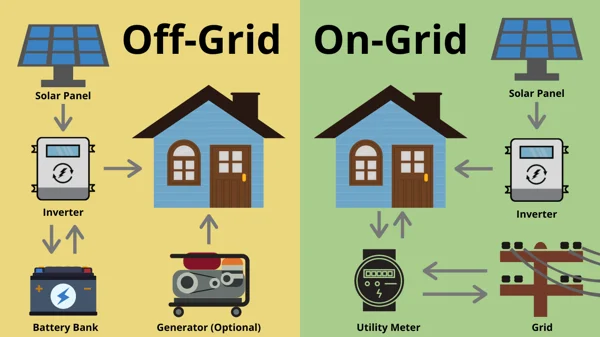
    When purchasing a solar system, you have two main options to consider: grid-tied vs. off-grid solar systems. As the name implies, grid-tied solar means the solar system is connected to the electrical grid, and off-grid solar means the solar system is not connected to the grid. 

    In order to pick the right type of system, it’s important to list the goals you’re hoping to achieve by adding solar energy. Here at Petersol Energy Limited, our primary focus is grid-tied solar systems, but we realize it’s important to consider the advantages and disadvantages of both grid-tied solar and off-grid solar, so you can identify the system that best meets your goals. 

    An off-grid solar energy system is not connected to the utility grid, whereas a grid-tied (aka on-grid) solar energy system is connected to the utility grid. Whether off-grid or on-grid system will determine your access to electricity, what equipment is needed for excess production, what happens when the grid goes down, and how you’re billed for electricity.

    Grid-tied Solar Systems

    What Is a Grid-Tied Solar System? 

    A grid-tied solar system is connected to the electrical grid and, unless special equipment is installed, requires the grid to be running for the solar system to produce energy. This type of system integrates seamlessly with the local utility grid, allowing homeowners and businesses to use solar power during the day and draw electricity from the grid when the solar panels aren’t generating enough energy, such as at night or on cloudy days. 

    Advantages of a Grid-Tied Solar System

    • Grid-tied systems tend to be the less expensive option due to not needing batteries and other equipment
    • This type of system is great for those who don’t have the room or financing to install a solar system big enough to cover 100% of their energy usage. You can continue to pull electricity from the grid if needed
    • Net Metering allows the electricity generated by a solar system to offset the electricity used from the grid during the night or on cloudy days
    • The grid becomes your cost-effective, reliable storage solution

    Disadvantages of a Grid-Tied Solar System 

    • If the grid goes down, your system will shut off, leaving you without power. This is required to prevent energy from backfeeding into the grid to keep utility workers safe.  Your grid-tied system will automatically shut off when the grid goes down and will also automatically turn back on when power is restored
    • You’re not completely independent from the grid

    Off-Grid Solar Systems

    What Is an Off-Grid Solar System? 

    An off-grid solar system operates independently from the electrical grid, making it a self-sustaining power source. These systems are designed to generate and store enough energy to meet all of a household’s power needs without any reliance on off-site power sources.  

    Many people like the idea of installing an off-grid solar system because of the independence and stability the solar system will bring to their lives. However, this is only achievable with the appropriate equipment. To achieve this, off-grid systems require a combination of solar panels, a battery storage system, charge controllers, and an inverter. All of the equipment needed to truly provide an off-grid whole-home system is costly.  

    The solar panels capture sunlight and convert it into electricity, which is then stored in the batteries for use when the sun isn’t shining. The charge controller regulates the energy flow, ensuring the batteries are charged efficiently and safely. The inverter converts the stored DC electricity into AC electricity, which can be used to power typical household appliances and devices. 

    While the independence offered by off-grid systems is appealing, it necessitates careful planning and investment in robust storage solutions to ensure a continuous and reliable power supply. This setup is particularly popular in remote areas where access to the electrical grid is limited or non-existent, but it also appeals to those who prioritize energy self-sufficiency and resilience.

    Advantages of an Off-Grid Solar System

    • Completely independent from the grid
    • A great solution for remote locations and underdeveloped communities

    Disadvantages of an Off-Grid Solar System

    • They are more costly
    • Batteries are required to deliver electricity consistently throughout the day and night
    • It could require a lifestyle change to reduce energy consumption
    • Surplus energy production could go to waste
    • Cannot rely on the grid at night or on cloudy days
    • Batteries require maintenance, have a relatively short lifespan, and degrade rapidly

    The Differences Between Off-Grid and Grid-tied Solar Energy Systems

    Difference #1: Your Access to Electricity

    Electricity Access with Off-Grid Solar

    What is meant by off-grid solar systems? With an off-grid solar system, you’re completely reliant on the sun and energy stored in batteries to power your home or business.

    If you opt for a solar system that is not tied to the electric grid and you do not have a generator, you will only have electricity at two points:

    1. When the sun is shining, and your solar system is producing electricity.
    2. When you’re pulling electricity previously generated by your solar system from a solar storage device, like batteries.

    If you do not have batteries or a means to store your energy, you will have less or no electricity when it’s cloudy and no electricity at night.

    With an off-grid system, you will not have access to extra electricity if you need it. What you are producing and what you have stored is all that’s there to power your equipment.

    Electricity Access with On-Grid Solar

    If you decide to install an on-grid solar system, you will always have access to electricity (unless the grid goes down), whether or not your solar system is producing, or if you have batteries.

    If your system is not producing any electricity or not producing enough electricity to power the devices, lights, machines, etc., that you’re using, you can pull energy from the utility grid to supplement it. This ensures you always have enough electricity for what you need.

    Difference #2: What Happens to Excess Production

    Excess Production with Off-Grid Solar

    Depending on the size of the system you install, how much electricity you use, and when you use that electricity, there will likely be times when your system is producing more electricity than you’re using. What happens to this excess energy depends on the equipment you install.

    Most off-grid solar systems are designed to produce a certain amount of “extra” electricity in the daytime, which is sent to batteries for storage. The energy stored in those batteries can then be accessed when the system is not producing, like at night or during cloudy weather.

    Depending on your energy goals, systems can be sized to produce enough excess electricity in the daytime to cover your entire energy usage around the clock.

    However, despite even the best and most accurate estimates, the weather is unpredictable. If you experience abnormally cloudy weather several days in a row, your system may not be able to produce enough electricity to charge the batteries and fulfill all your needs.

    While having extra batteries offers peace of mind and can provide a bank of stored electricity just in case this happens, they’re also expensive. Purchasing more batteries than you need may be cost-prohibitive, depending on your budget.

    Excess Production with On-Grid Solar

    Just like off-grid solar systems, many who choose to install an on-grid solar system want to cover 100% or nearly 100% of their energy usage. This can be achieved with on-grid systems as well.

    Depending on the time of day you use electricity, your solar system can produce excess energy. Instead of sending it to batteries as you would in an off-grid system, you can send it to the grid, and you will be compensated for that electricity.

    Many  will be compensated through something called net metering. Net metering is when the utility company compensates or credits your account for electricity generated by your solar system and sent to the grid. Then, whenever you need to draw energy off the grid, you’ll be drawing on those credits to get your electricity without racking up charges on your electricity bill.

    Difference #3: What Happens When the Grid Goes Down

    Power Outages with Off-Grid Systems

    Your solar system is working independently from the power grid. If there’s a bad storm or event that knocks out the power, your solar system can continue operating. You won’t notice changes in your service or access to electricity.

    Power Outages with Grid-Tied Systems

    By connecting to the grid, you get access to electricity whenever you need it. However, you’re also subject to some rules. If you have a grid-tied solar system and the grid goes down, you will not have electricity unless you opt for a grid-tied solar system with battery backup.

    Difference #4: How You’re Billed for Electricity 

    Electricity Bills with an Off-Grid System

    If your PV system is not tied to a grid, you won’t receive an electric bill at all. However, even with no electric bill, off-grid systems are often more expensive because of the additional equipment, like batteries, that are needed to make it viable.

    Electricity Bills with a Grid-Tied System

    If you opt for a grid-tied system, you may still see minimal charges on your electricity bill, even if your solar system provides 100% of your electricity.

    One type of charge you may continue to see is the service fee or delivery charge. This is the cost levied on customers for connecting their home or business to the grid. For many utilities, this fee is a flat rate that is not impacted by how much electricity you use.

    Another type of charge you can see is demand charges. Demand charges are typically levied on commercial properties and are the increased electric rates you pay for the power you use during a peak demand period. The peak demand period is typically the 15-minute period in which your business uses the most electricity.

    Because using a large amount of electricity at one time puts a strain on the grid, the utility will charge a higher rate for the electricity used during that period.

    If your peak demand period is during the day, you may be able to reduce it with solar, as energy produced by your system will compensate for some of the energy you use from the grid. If you pay very high demand charges, you may also want to look into peak demand shaving with solar and batteries.

    Hybrid Solar Energy Systems

    A hybrid solar energy system is tied to the grid but also has a battery bank to store unused electricity. Though more expensive due to the added cost of batteries, hybrid systems allow their owners to keep the lights on when the grid goes down and can even help reduce demand charges for businesses.

    While there are distinct differences between off-grid and grid-tied solar systems, the one that is best for you is dependent on your situation. Off-grid systems allow for complete freedom from the utility, but they’re often more expensive. Grid-tied systems marry significant electricity savings with grid-backed dependence, so you’ll never have to worry about not having the electricity needed to power your house or business.